
Nathan's company didn't go bankrupt that day. I didn't want innocent employees to be harmed because my husband had confused access with ownership. But his role changed with surprising speed as soon as people understood the difference between a private lapse and the misuse of professional privilege. He was removed from travel partnerships with clients. Then, from a hospitality campaign he boasted of leading. Next, his board requested an internal review of expenses related to airport services.
The word "evaluation" sounded mild.
Nathan knew this.
He called twenty-two times in a single afternoon.
I didn't answer.
Vanessa, however, discovered that luxury loses its essence when people stop believing the story that accompanies it. Her photos on social media, taken in lounges and private suites, disappeared one by one. The captions about elegance personified vanished. Of course, people had screenshots. They always do. But I didn't participate. I had no desire whatsoever to feed the crowd more than the truth demanded.
Then Vanessa sent me an email.
The email subject line was: Please read before Nathan lies again.
I almost passed out. Instead, I opened it while I was in the kitchen, watching my mother arranging lemons in a bowl, because she organized fruit when she was worried.
The email wasn't polished. That made it more believable.
Nathan told me you two had an agreement, Vanessa wrote. He said the marriage was only public. He said you knew about me, but wanted privacy. I believed what suited me. I'm not naive. But now he's saying I used him and shamed him. That's not true.
Attached are some screenshots.
Nathan telling her to use the private hallway because my wife never checks those things.
Nathan joked that my family valued discretion, so that no one would ask questions.
Vanessa asks: Does Clara really know?
Nathan replied: She knows what I need her to know.
I sat down.
That sentence was worse than the kiss.
She knows what I need her to know.
He summed up the entire marriage in seven words. Nathan hadn't just lied. He had treated my conscience as something he managed, rationed, and edited. The truth was a room I could only enter when he opened the door.
My mother read my expression and sat down silently beside me.
I saved the email in the Terminal 4 folder. I didn't thank Vanessa. Not at that moment. Gratitude can be mistaken for forgiveness when people are desperate for absolution. Vanessa had sent the truth because protecting Nathan had turned into guilt. Even so, the truth mattered. Motives don't need to be pure for evidence to be useful.
A week later, Nathan sent a letter through a lawyer. In it, I was accused of damaging his reputation, blocking access to shared services, and causing unnecessary public embarrassment. The letter was written in the formal language of someone trying to make the consequences sound like attacks.
I read it at the dinner table and then put it in my folder.
There were records. There were dates and times. There were ownership documents. There were messages from Nathan himself. And, most importantly, the facts were understandable. He had lied, used an account linked to my name, and been watched.
My answer was simple.
He could collect his personal belongings by appointment. He could communicate through formal channels. He could not enter the residence, use airport services, present himself as if he had access to the premises, or contact my parents.
No threats. No dramatic language.
Only limits.
Nathan hated limits, especially when they were clearly defined.
He arrived two days later with a moving company and a representative. I wasn't alone. My father sat in his office with the door open, reading a book he had no intention of finishing. My mother calmly arranged flowers in the dining room with deliberate deliberation. A household manager supervised the movers.
I was near the stairs, wearing a cream-colored blouse and dark pants.
Nathan entered the entrance hall like a man visiting a museum where his portrait once stood. He looked at the sideboard, the rug, the staircase, the spot where our wedding photo had been removed from its frame. His eyes lingered on that empty space.
I observed the pause and felt no triumph. No sharp pain. Only recognition.
The house had already begun to forget him.
He approached with his coat draped over one arm. "Are you really going to stand there like I'm a stranger?"
"You are here to collect your belongings."
"Clara."
My name sounded different coming from his lips now. Less like a term of endearment. More like a key he was trying to fit into a different lock.
"You're letting your parents turn you against me," he said.
My father looked up from his desk. He said nothing. His silence carried more weight than any words.
I didn't take my eyes off Nathan. "My parents saw you leaving the arrivals area with Vanessa while you were telling me you were abroad. You did the conversion yourself."
He flinched at the frankness. For years, I had softened my words around him. It had made him lazy.
The porters carried boxes down from the room. Suits. Shoes. Golf clubs. Framed awards that Nathan had bought in expensive frames after being featured in a regional business magazine. Each item passed through the hallway like a small ego trip.
"You're going to miss this life," he said.
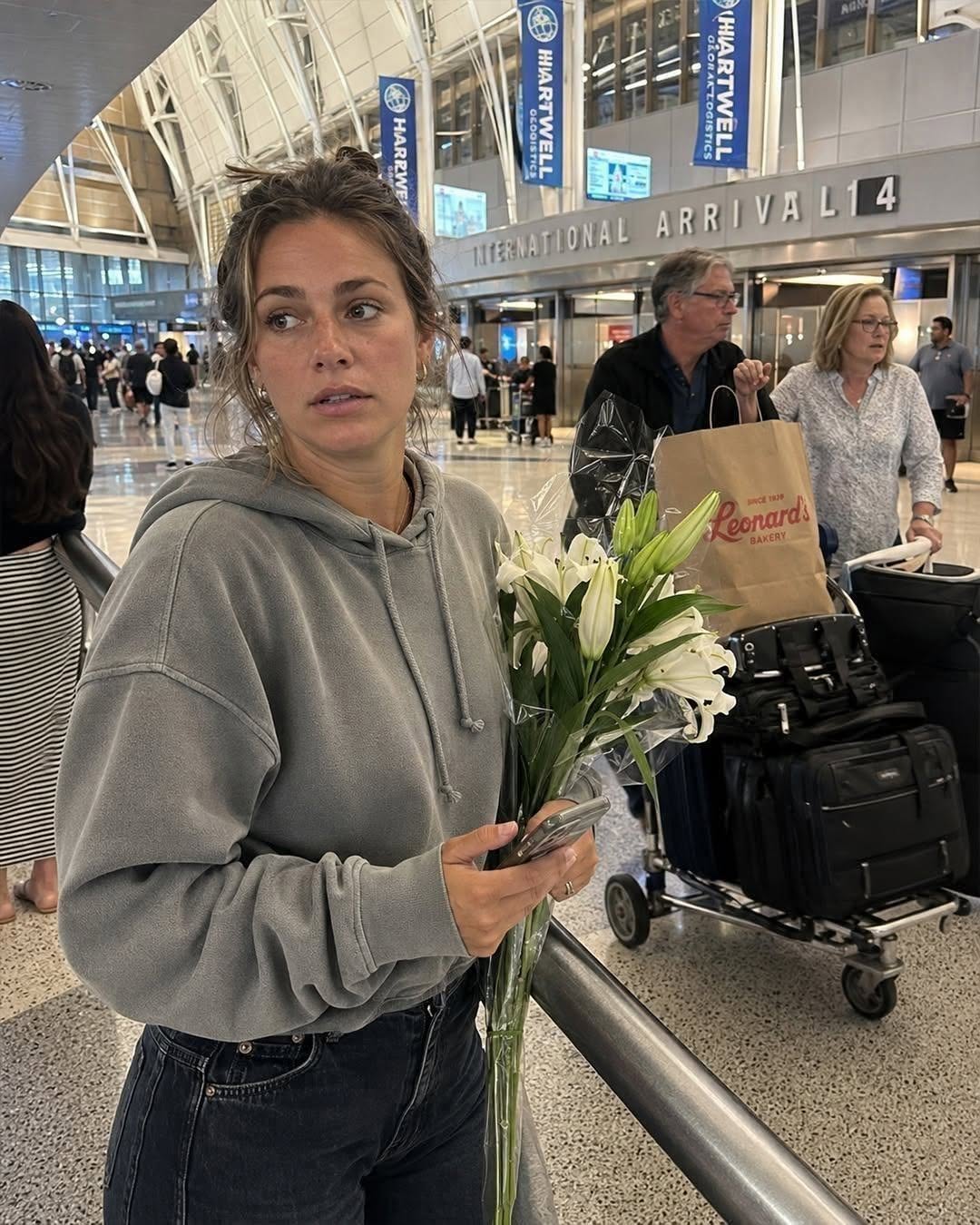
I almost smiled, not because it was funny, but because it was so typically Nathan. Even at the end, he felt like life was his. He didn't see the house, the parents, the quiet nights, the foundation work, the airport responsibilities, the white lilies, the kitchen island, the rooms that were always peaceful when he was away.
“No,” I said. “I’m going to miss who I thought you were. This is different.”
For a second, his face opened up. The phrase reached some vulnerable part of him. Then pride closed it again.
His phone rang.
Vanessa's name lit up the screen.
I saw it. He saw me see it.
The atmosphere became painfully silent.
He refused the call.
First I looked away, not because it hurt, but because it no longer mattered.
When the movers finished, Nathan stood near the door. The entrance step was clean. The bouquet damaged by the rain was gone. The house didn't appear damaged.
"This is not over," he said.
I nodded once. "For you, perhaps."
Then the door closed behind him.
My mother entered the entryway and placed fresh white lilies on the sideboard. No one commented on the symbolism. It wasn't necessary.
The public setting that Nathan dreaded emerged at the airport's annual development dinner, an event he had struggled to attend because his absence would be interpreted as an admission of guilt. The committee, anxious to avoid drawing further attention, allowed him to participate as a regular guest.
I attended as a representative of the hospitality arm of the Whitmore Trust. Most guests knew my family name. Fewer people understood what my authority truly meant. Nathan had built years of trust by bridging that gap.
Dinner was held in a glass atrium overlooking the runways. Planes moved in the distance like illuminated ships crossing a dark sea. Tables were set with blue tablecloths and low silver lamps. Screens displayed designs for new family waiting areas, clearer signage, and improved staff support. It wasn't extravagant. It was elegant, functional, civic. Exactly the kind of environment Nathan liked to be in, as if he had built it himself.
I arrived alone, wearing a black dress and a white coat draped over my shoulders.
Nathan arrived ten minutes later with Vanessa.
Everyone in the room noticed.
Vanessa wore a light gold dress, softer than the red travel dress, perhaps to suggest innocence. She kept one hand on Nathan's arm, but her eyes moved too frequently, observing faces, calculating whispers. Nathan smiled exaggeratedly at people who greeted him cautiously rather than cordially.
I expected him to come alone. Bringing Vanessa was either arrogance or desperation. Maybe both. He wanted to prove that the relationship was legitimate now, that the scene at the airport was just the turbulent beginning of a new public couple. Men like Nathan often believe that if they stick around long enough, the situation becomes a decision.
The seating arrangement was the first silent blow.
Nathan and Vanessa were seated at a side table near the service entrance.
My business card was on the central table, next to the airport official's chair.
Nathan noticed immediately. His lip twitched. Vanessa stared at the graph as if she expected him to apologize.
I sat down without looking at them.
Halfway through the program, the host announced a new policy for executive guest access. The language was simple: no borrowed spousal authorization, no unidentified guests, no use of private hallways without direct approval, no exceptions based on status.
The room responded with polite applause.
Most people have heard of good governance.
Nathan heard a lock turning.
Then I was invited to speak.
I walked to the stage under a bright white light. I looked first at the staff tables: the people in uniform, headphones, name tags, and comfortable shoes—those who made the journey seem human, while men like Nathan treated access like a personal crown.
My speech was brief. I spoke about trust in public spaces. I spoke about how private service should never become an acquired right. I spoke about protecting employees from pressure exerted by names that sound important. I didn't mention Nathan.
I didn't need to.
Towards the end, I paused and looked down at the arrival hall, which was visible through the glass below.
“An airport is where people return home,” I said. “No one should use that sentiment as a pretext for a lie.”
Silence filled the room.
CONTINUE READING...>>
To see the complete cooking instructions, go to the next page or click the Open (>) button and don't forget to SHARE it with your friends on Facebook.